World First: Sprayed UHPC Technology Protects Cross-Sea Bridge Piers
Revolutionary marine structural protection: Sprayed UHPC achieves 80MPa in 24 hours for Hangzhou Bay bridge repair.
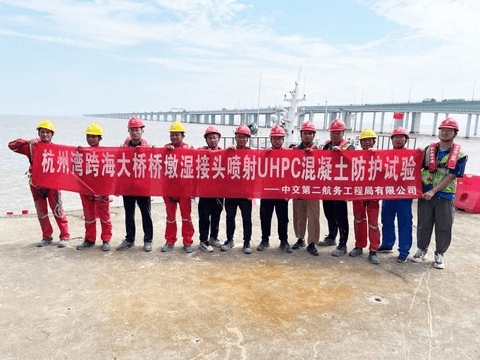
HANGZHOU BAY, CHINA – In a landmark achievement for marine engineering, the world’s first successful application of sprayed Ultra-High Performance Concrete (UHPC) technology has been completed for the protection of wet joints on cross-sea bridge piers. This breakthrough was implemented during the maintenance and durability improvement phase of the Hangzhou Bay Cross-sea Bridge (2023-2024).
Developed through a four-year collaboration between the CCCC Second Navigation Engineering Bureau and the Ocean University of China, this technology addresses the critical challenge of maintaining structural integrity in one of the world's most volatile tidal environments. After 15 years of service, the bridge's wet joints—the critical connection points between precast elements—showed signs of typical marine distress, including micro-cracking and chloride-induced corrosion.
Engineering Challenges in Harsh Marine Environments
The Hangzhou Bay region is notorious for its complex hydrologic conditions: high tidal ranges, rapid currents, and high salt-mist concentrations. Traditional repair methods often fail due to the short "window periods" between tides and the difficulty of achieving high-bond strength in humid, saline conditions.
To overcome these hurdles, the engineering team developed a specialized UHPC formulation and a complete "materials-equipment-construction" ecosystem. The technical specifications achieved during this project set a new global benchmark for marine repair:
| Performance Metric | Technical Achievement |
|---|---|
| 1-Day Compressive Strength | > 80 MPa |
| Impermeability Grade | > P40 (Extreme resistance to chloride ion penetration) |
| Pumping Distance | > 50 meters (Vertical/Horizontal) |
| Initial Setting Time | < 10 minutes (Rapid hardening for tidal windows) |
| Slump Retention | > 4 hours (Extended workability for complex pumping) |
Innovation in Equipment and Material Delivery
The success of the project relied on a creative "wet spraying" system. Unlike traditional casting, the sprayed UHPC utilizes special rheology regulators and ultra-fast hardening agents. This allows the material to be pumped over 50 meters and adhere to vertical pier surfaces without sagging, even in high-humidity environments.
For international contractors managing similar marine infrastructure—such as those in the Middle East or Southeast Asia—this technology offers a significant leap in service life extension. The high density of the UHPC matrix effectively "seals" the wet joints against the ingress of salt water, preventing rebar corrosion at its source.
Future Applications
This "New Quality Productivity" model is expected to be exported to global markets where existing marine structures are reaching critical maintenance milestones. The technology is not limited to bridges; it has broad prospects for:
- Tunnel Support: Rapid lining reinforcement in high-pressure water zones.
- Marine Structures: Port wharves, offshore wind power foundations, and sea walls.
- Structural Retrofitting: Strengthening of aging urban infrastructure with minimal footprint.
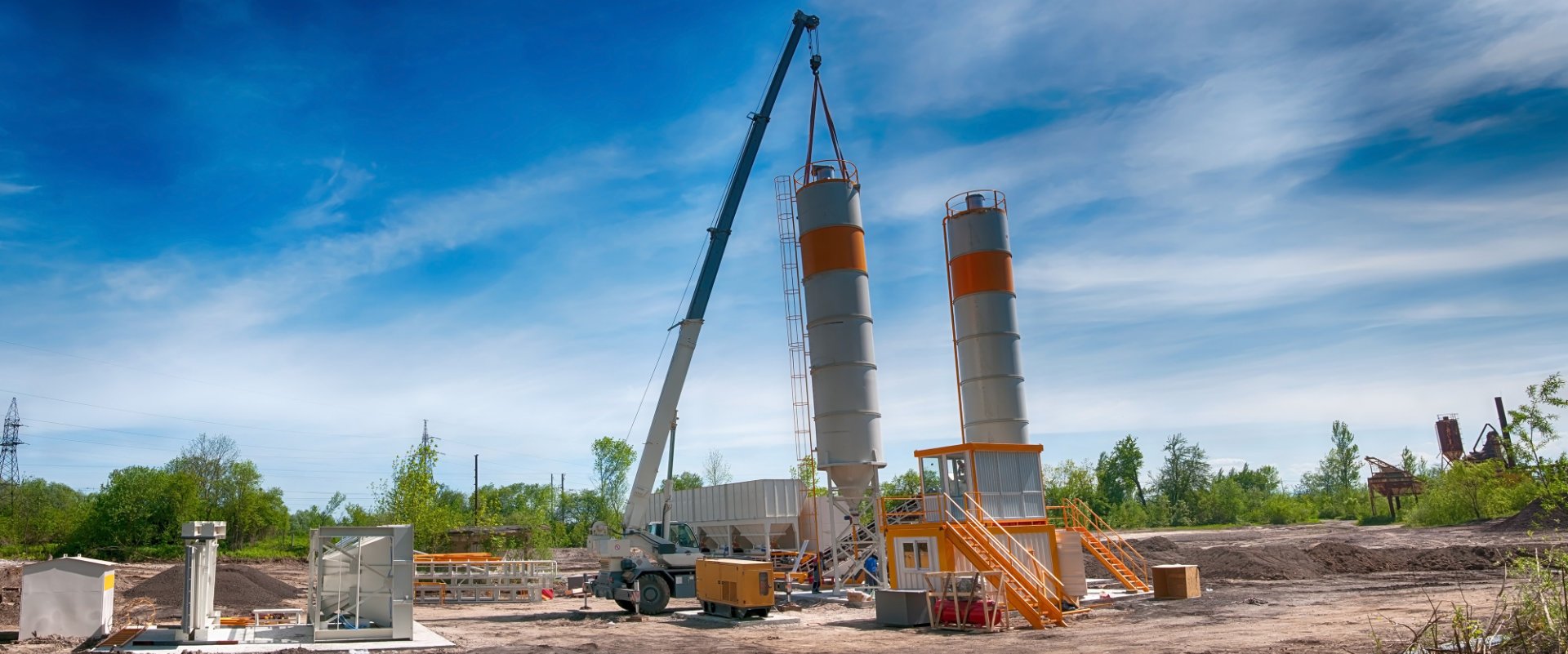
As a leading provider of mixing technology, Xingye Machinery continues to monitor these technical advancements to ensure our equipment—including our HZS series batching plants and specialized planetary mixers—remains compatible with the next generation of high-performance materials like UHPC.
For technical specifications on mixing equipment capable of handling UHPC and other high-performance concretes, contact our engineering department for a consultation.
Related Posts :