Concrete Mixer Fleet Sizing: How to Eliminate Site Bottlenecks
Stop guessing your fleet needs. Use engineering-grade calculations to optimize your HZS plant's delivery cycle.
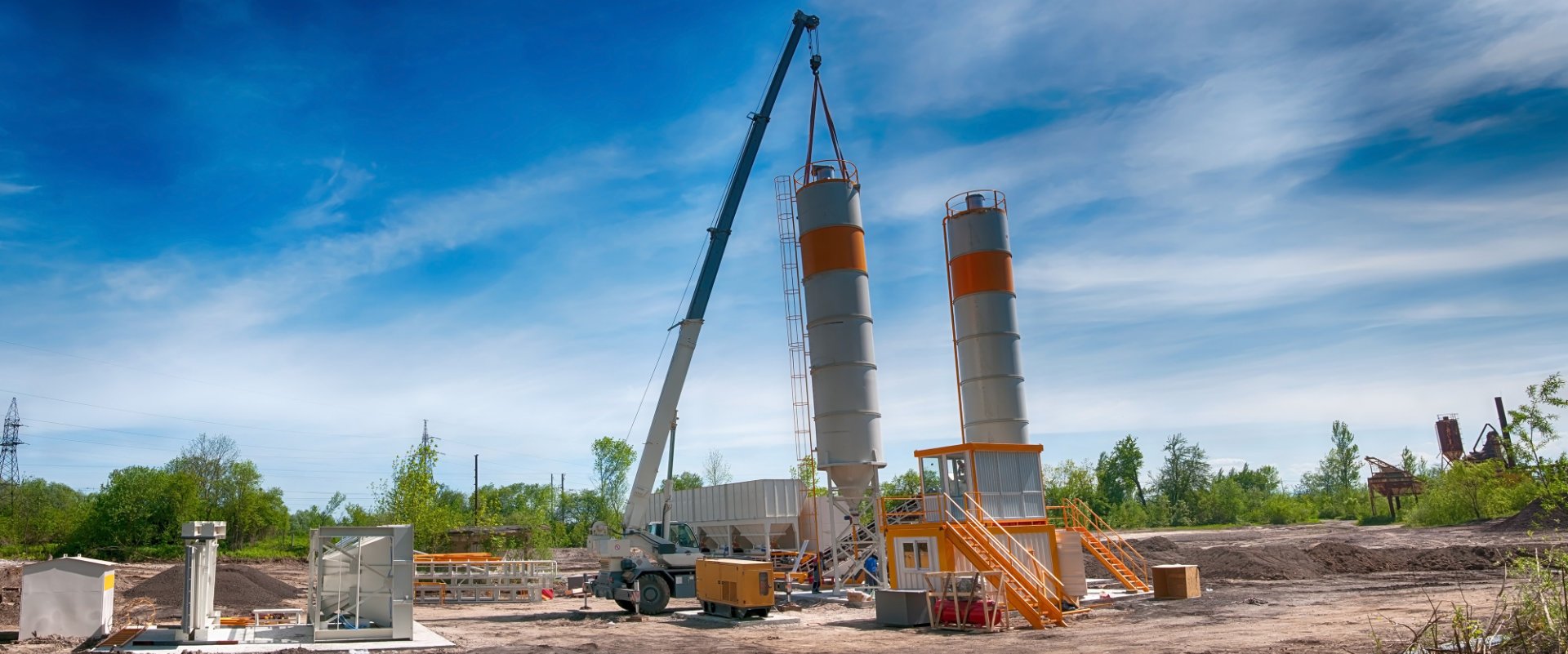
In high-stakes construction, the bottleneck is rarely the batching plant itself—it’s the logistics chain. If you have too few mixer trucks, your HZS concrete plant sits idle, wasting energy. Too many, and you face a line of idling trucks, skyrocketing fuel costs, and the risk of concrete setting in the drum during high-temperature pours in regions like the Middle East or Southeast Asia.
To maintain a seamless "just-in-time" delivery flow, fleet sizing must move from guesswork to engineering precision.
The Core Fleet Sizing Formulas
To determine your required fleet size (n), you must balance the hourly output of your plant against the transport efficiency of a single unit.
Formula 1: The Fleet Requirement
n = Qh / Qn
- n: Number of required mixer trucks.
- Qh: Actual batching plant productivity (m³/h).
- Qn: Transport efficiency of a single mixer truck (m³/h).
Formula 2: Single Truck Efficiency (Qn)
Qn = (kn × kt × Q × (1 - β)) / T
| Variable | Definition | Standard Value / Range |
|---|---|---|
| kn | Fill factor (Drum utilization) | 0.8 – 1.0 |
| kt | Time utilization factor | 0.8 – 0.9 |
| Q | Rated mixer truck capacity | e.g., 8m³, 10m³, 12m³ |
| β | Unloading residual (Waste) | Typically 0.01 (1%) |
| T | Total cycle time (Hours) | Includes loading, transit, and discharge |
Practical Case Study: HZS35 Plant Optimization
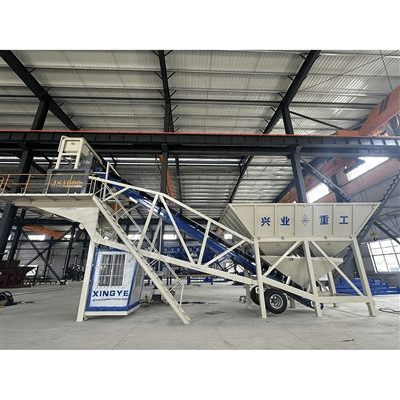
Consider a project using an HZS35 concrete batching plant (rated at 35-36 m³/h) with 12m³ mixer trucks and a 90-minute (1.5h) round-trip cycle time.
Step 1: Calculate Transport Efficiency (Qn)
Assuming a fill factor of 0.9 and time utilization of 0.8:
Qn = (0.9 × 0.8 × 12 × 0.99) / 1.5 = 5.7 m³/h per truck
Step 2: Calculate Required Fleet (n)
n = 36 / 5.7 ≈ 6.31
The Verdict: You require 7 trucks to ensure the plant never waits for a vehicle. Deploying only 6 trucks would result in a 5% drop in total site productivity.
3 Factors That "The Math" Often Misses
While formulas provide the baseline, Xingye Machinery’s field engineers recommend adjusting for these regional realities:
1. Slump Loss in Hot Climates
In markets like Saudi Arabia or the UAE, high ambient temperatures accelerate concrete setting. If your cycle time (T) exceeds 90 minutes, you may need to increase fleet density or utilize chilled water systems in your batching plant to maintain workability.
2. The "First Load" Bottleneck
At the start of a shift, all trucks are at the plant. By the second hour, they are staggered. We recommend "buffer sizing"—adding +1 truck to the calculated n to account for unexpected traffic congestion in urban centers like Manila or Bucharest.
3. Discharge Speed Constraints
A 12m³ truck can discharge in 15 minutes into a large foundation pour, but may take 45 minutes if discharging into small buckets or manual forms. Always adjust T based on the receiving end of the project, not just the driving time.
Need to optimize your site logistics? Xingye Machinery provides integrated solutions—from HZS-series batching plants to high-durability concrete mixer trucks—designed to work in sync. Contact our engineering team for a customized fleet productivity analysis.
Related Posts :